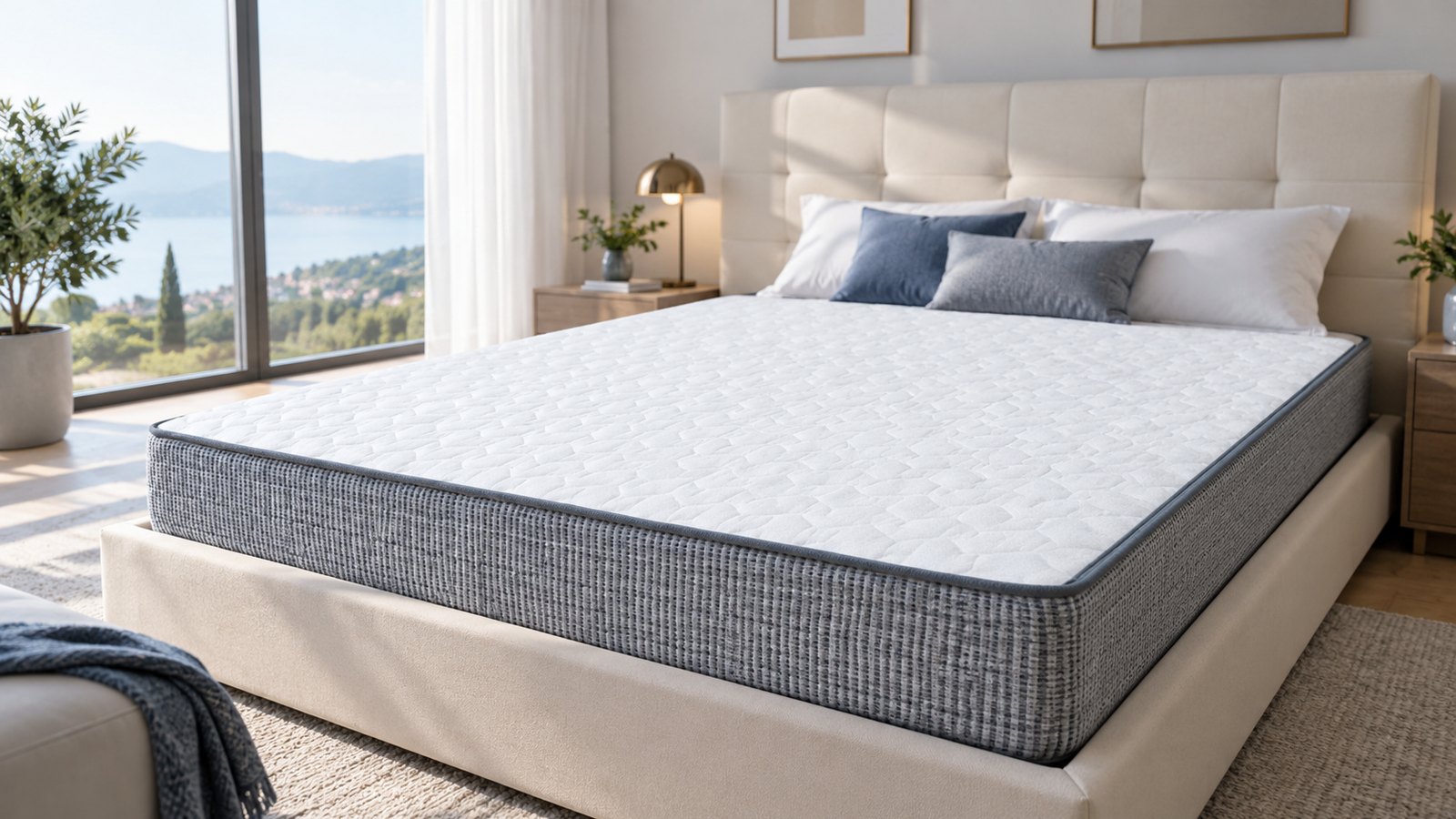
Sleep and noise: how to protect your rest from unwanted sounds
By day, city noise stays in the background: traffic, the lift, the fridge humming in the kitchen. At night those same sounds walk into the bedroom and take centre stage. The body never stops listening when you close your eyes. It keeps guarding the room, and every sudden sound is registered before the mind has time to name it.
Sleeping well comes from a whole system: steady hours, controlled light, a cool room and a surface that does not let you down. Noise is the fifth element, the one that quietly undoes the other four. A bedroom with the perfect temperature and a good mattress can still stay awake if a lift starts at two in the morning or a pipe knocks inside the wall.
You do not need to move to the countryside to fix this. You need to measure, isolate and choose what sits inside the bed. The complete Luxury Relax review describes the materials and services of an Italian brand built around night-time quiet, with 10 trial nights to check the result in your own bedroom.

Why noise breaks your sleep even when you do not wake up
Sleep is not a light switch. It is a sequence of stages that repeat in cycles of roughly ninety minutes. A sudden sound does more than wake you: it shortens the deep phase, raises the heart rate and pulls the body towards the surface. The next morning feels like a broken night even without a single remembered awakening.
Levels help to see what is at stake. A whisper sits around 30 decibels, a conversation around 60, city traffic between 70 and 85. At night, though, the change matters more than the volume: a steady hum disappears within a few nights, while a front door slamming at three stays an event every single time.
Sensitivity differs from person to person. Children, light sleepers and anyone in an unfamiliar room react to sounds well below the average. Bed position counts too: a headboard against a shared wall carries structural noise far better than most people expect.
Living with regular noise raises your threshold, but the bill still arrives: less time in deep phases, more turning during the night. If you suspect the problem runs wider than the room, the mattress guide for insomnia covers what genuinely helps, from evening rhythm to the surface you sleep on.
The noise map of your home: find where the problem starts
Before spending money on new shutters, take ten minutes for a survey. In the evening, with the house quiet, listen to one source at a time: the fridge vibrating against the wall, the boiler firing up, water running through the upstairs bathroom pipes, the neighbour's television through the partition. Writing the list is already half of the job.
Each source has its own fix, and few of them are expensive. The goal is not to erase every sound: it is to remove the sudden peaks that cut the sleep cycle in half.
| Source | Indicative level | Practical fix |
|---|---|---|
| Street traffic | 70-85 dB | Shutters down and heavy curtains |
| Fridge or freezer | 35-45 dB | Move it or add an anti-vibration pad |
| Neighbours and upstairs footsteps | 40-60 dB | Rug and a bookcase on the shared wall |
| Phone and notifications | 60-90 dB | Night mode and vibration off |
| Water in the pipes | 30-50 dB | Insulate the pipes or close the valve at night |
Timing matters too: the best structural jobs fit into a weekend, when you can move the bed and test different layouts, while the daily measures settle within two weeks. Keep a small diary for ten nights: bedtime, noticed awakenings, how noisy the room felt in the morning. After ten nights you can see clearly which change made a difference and which did not, instead of trusting the feeling of the moment.
One practical detail: the bedroom is the only room where moving furniture for acoustic reasons actually pays. A headboard away from the shared wall, a thick rug on the floor and a full bookcase as a screen soften household noise better than many products sold as "soundproofing". Follow the budget in order: internal sources first, then the shell, then the accessories.

A quiet bedroom: the fixes that actually work
A quiet bedroom is built in two layers: structure and habits. On structure, the levers are three: window, floor and door. Full-length lined curtains and shutters pulled down cut street noise; a thick rug on an anti-slip underlay reduces footfall noise and what rises from the flat below; seals around the door stop sound from the stairwell.
On habits, a few gestures repeated at the same hour each evening are enough. Phone on night mode with the screen face down, noisy appliances away from the bedroom, window closed before 11 pm on busy streets. Light sleepers can try the steady sound of a fan on low speed: a stable hum masks peaks far better than total silence.
Temperature remains an ally of quiet. A room around 18-20 degrees, well aired, cuts awakenings and makes sleep more continuous, so noise disturbs less. And when the street cannot be switched off, build a routine that tells the body the day is over: warm light, few screens, the same bedtime from Monday to Sunday.
When the noise comes from the bed
Some sounds no curtain can stop, because they start thirty centimetres from your ears. An old bed frame creaks when you turn, a mattress that has lost its bounce carries every movement, and a partner moving sends the swing across the whole surface. These are the sounds of the bed, and at night they weigh as much as traffic.
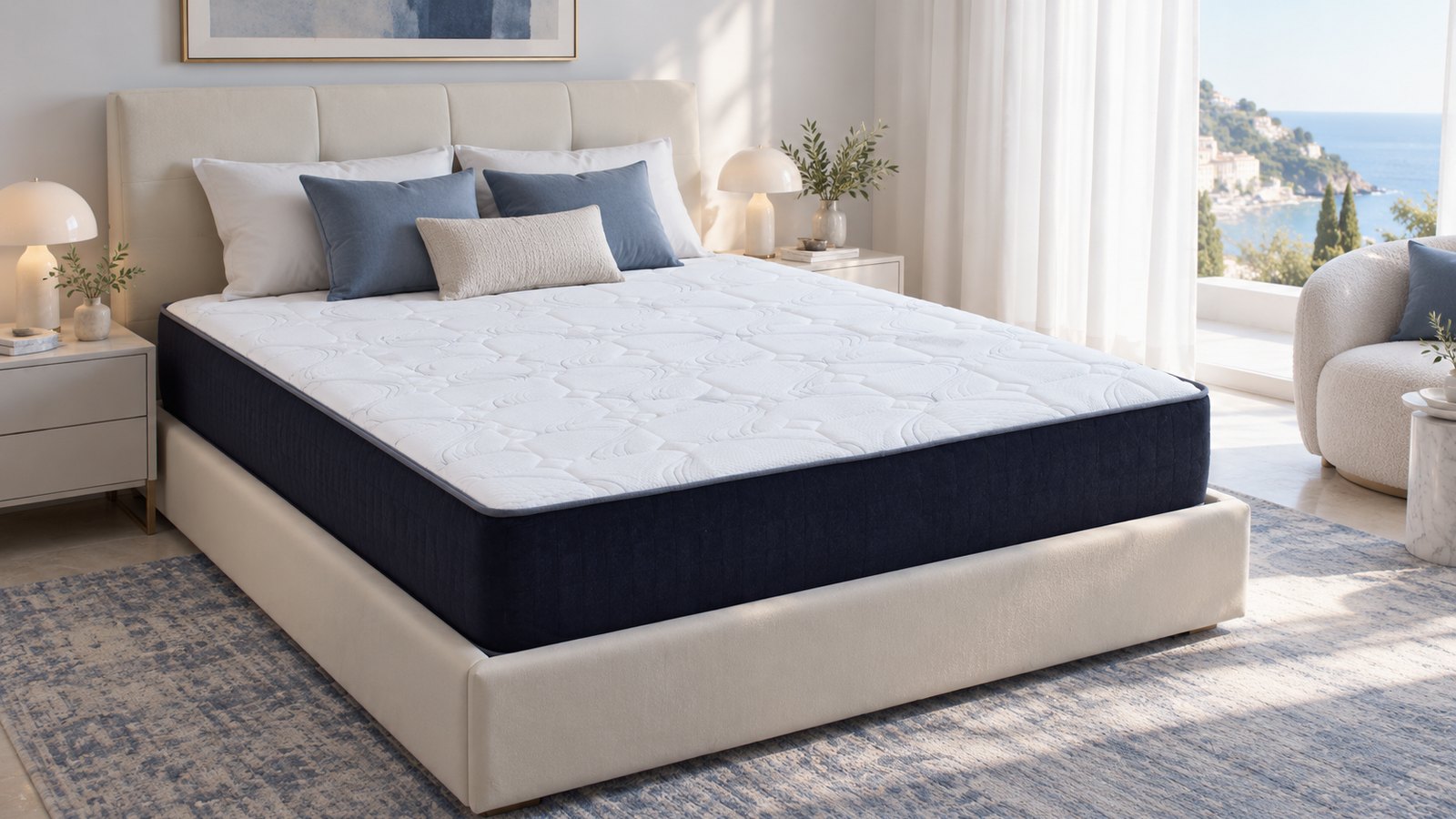
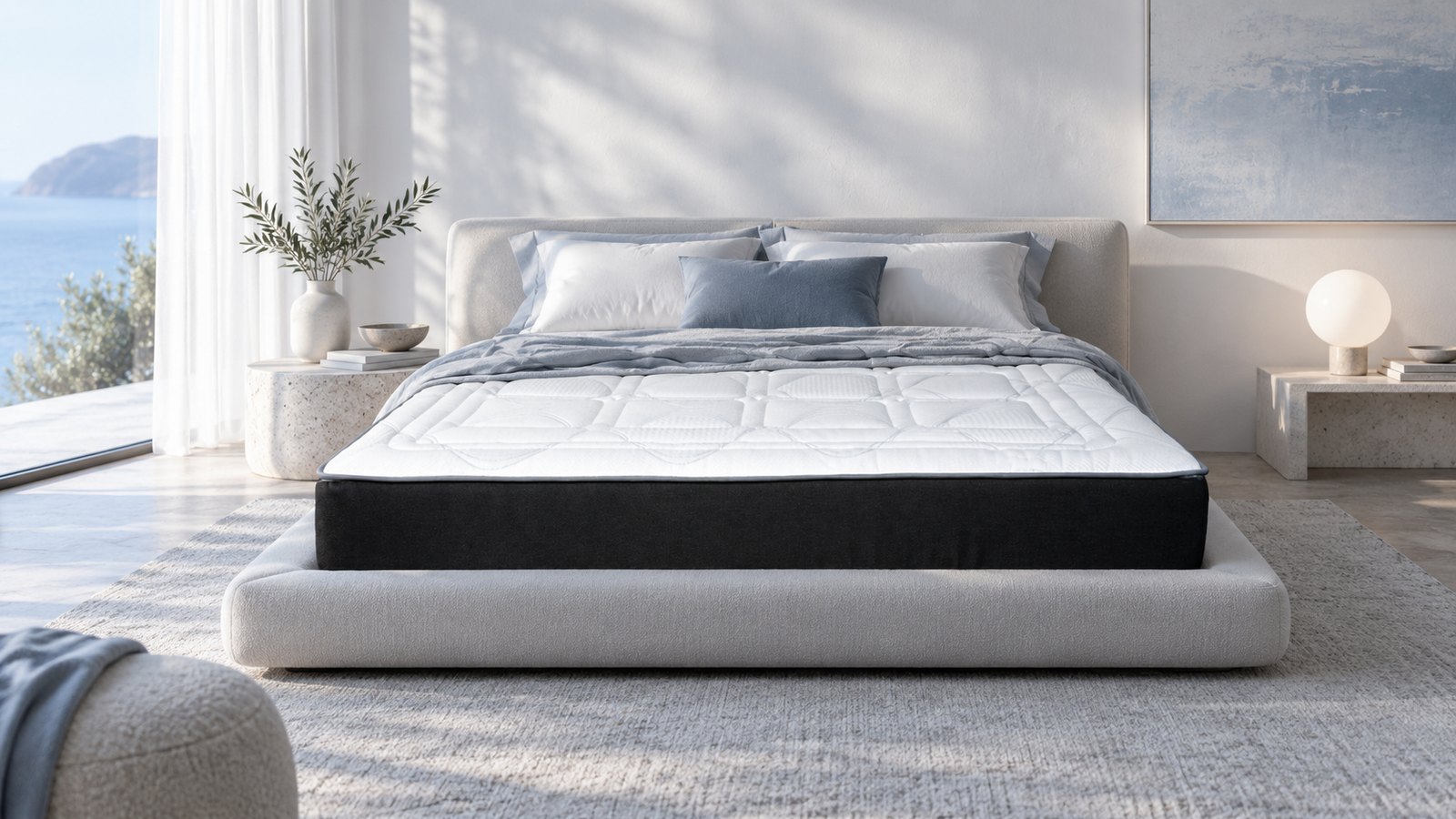
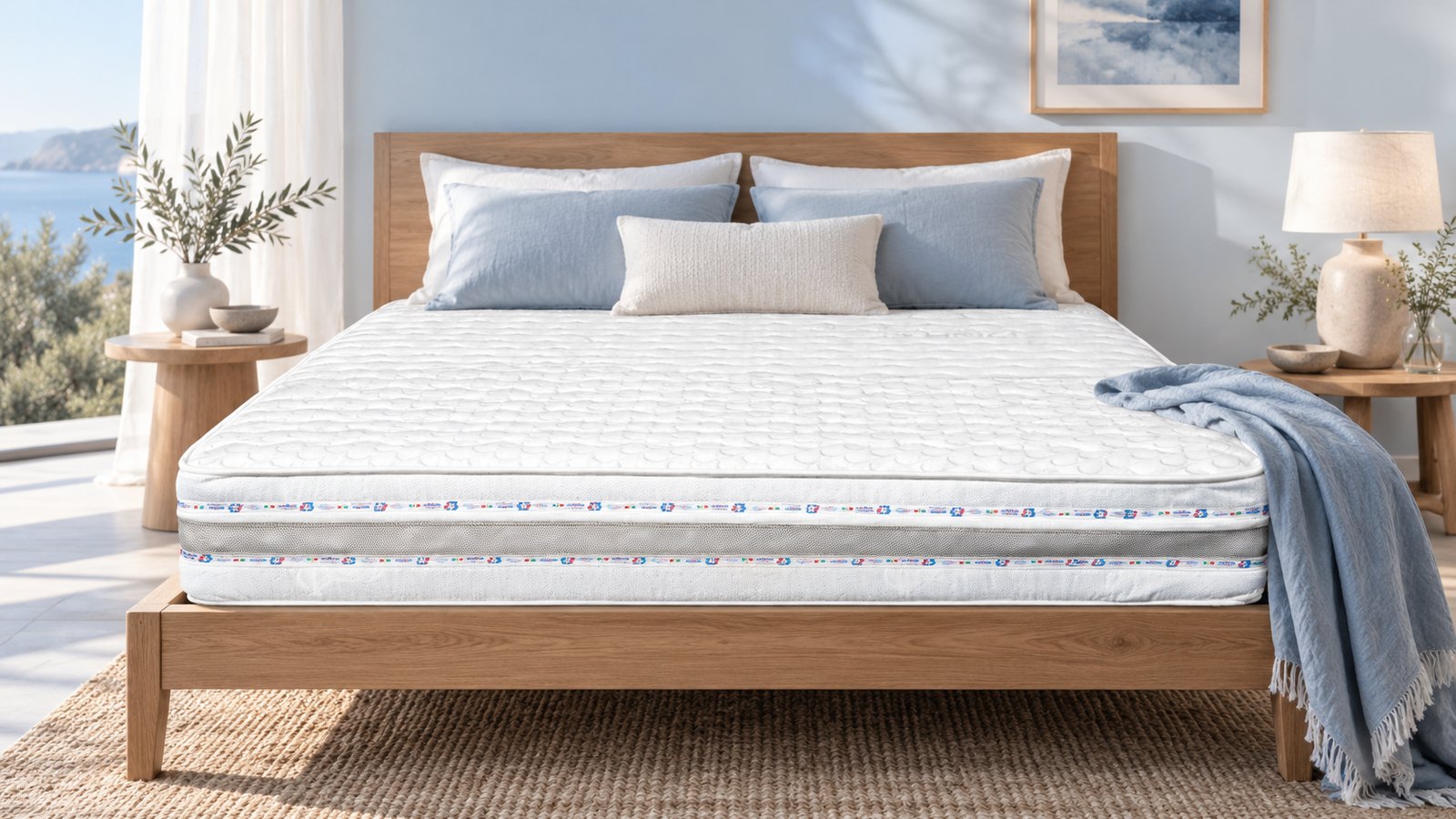
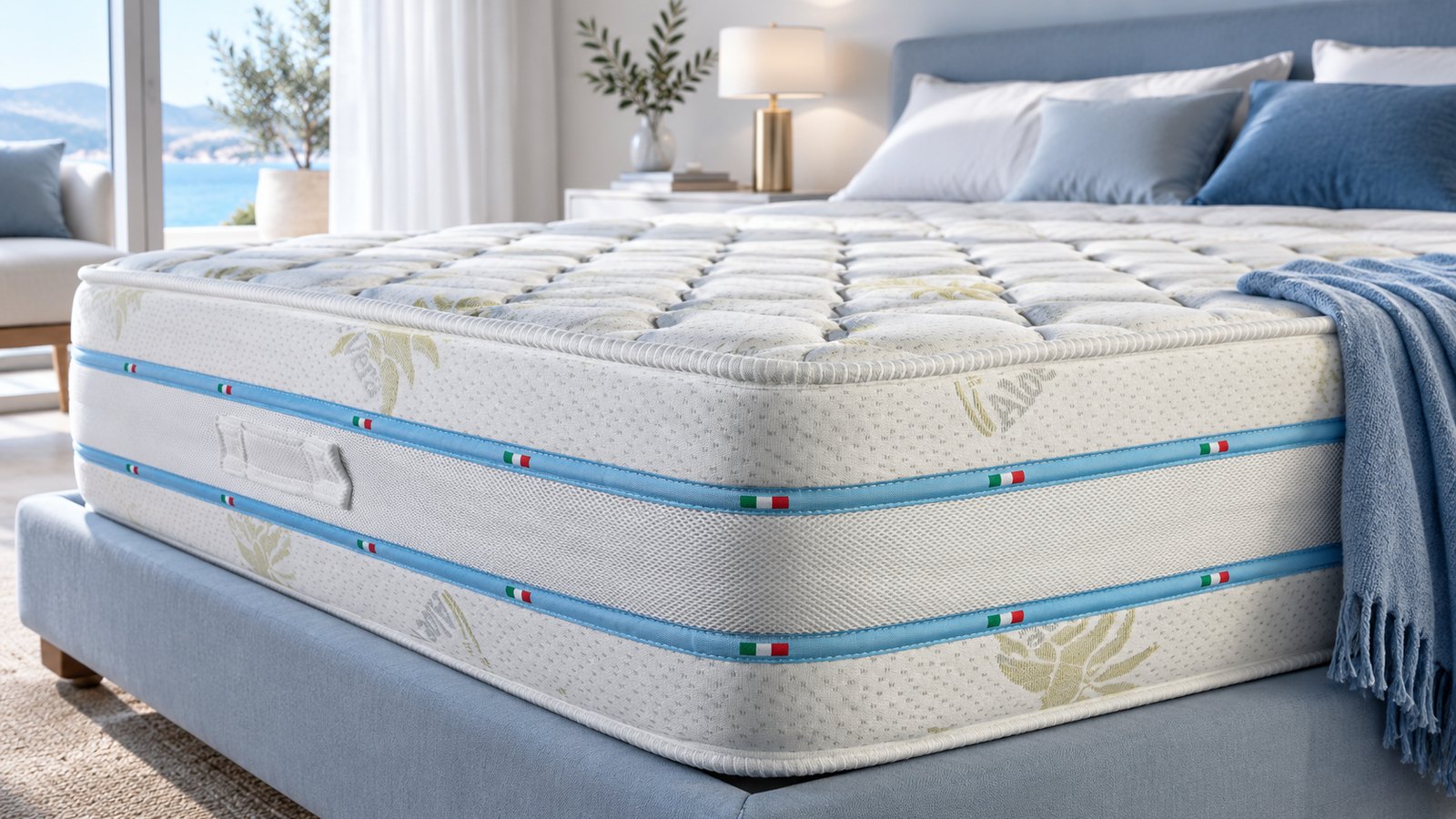
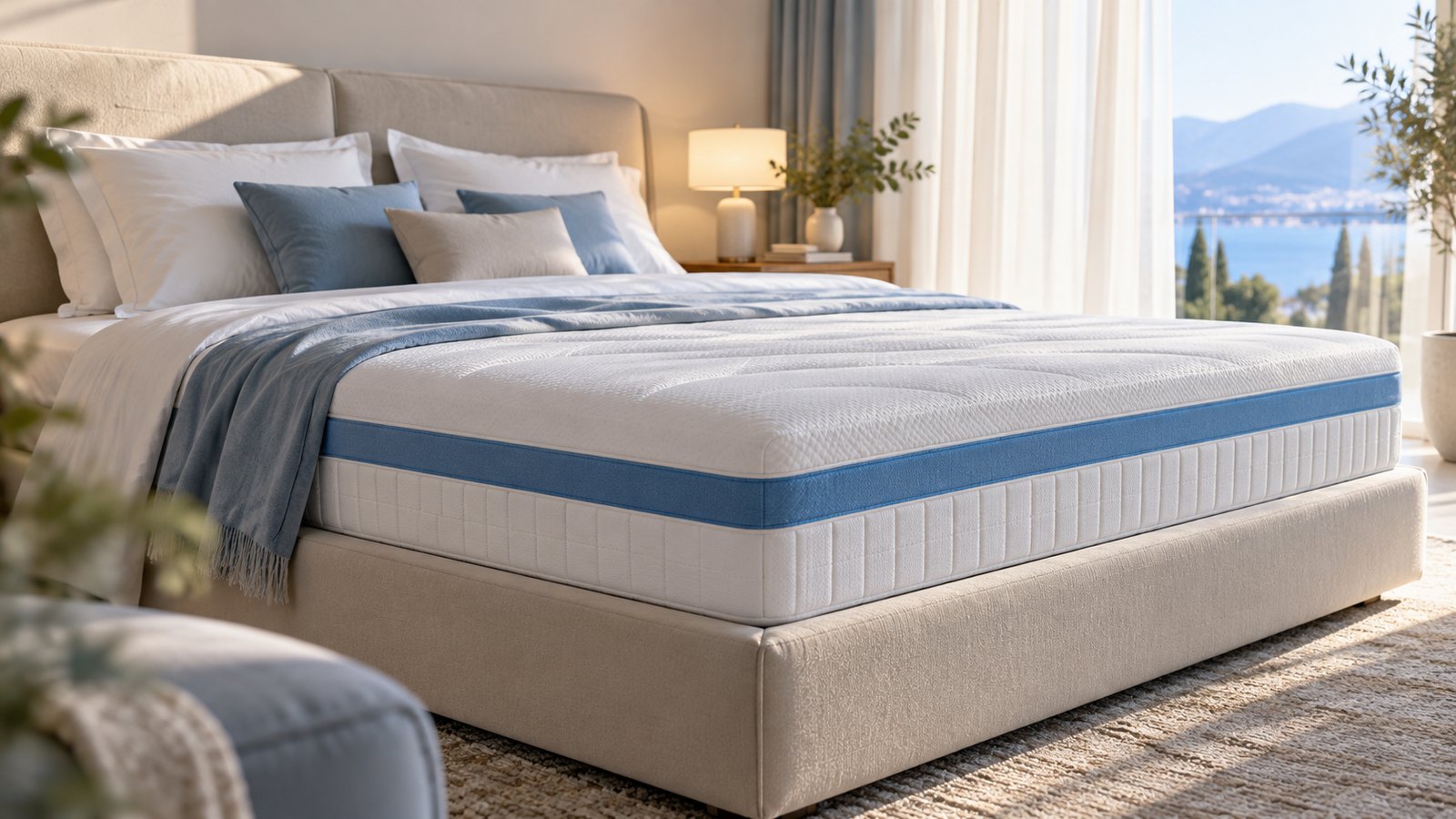
The first lever is the complete system: mattress and bed base must work together, with no play between the two parts. The second is the mattress structure. The differentiated support in Luxury Relax mattresses holds head, shoulders and hips at different firmness levels along the surface, so movements stay local instead of travelling to the other side. The high-density Confortgel base and the temperature-sensitive memory foam follow the body without creating collapse points, and the 3D breathable perimeter band keeps the structure dry.
The range covers every budget without cutting the services: Luxury Relax Venere mattress from 149 euros, Elisir from 179 euros (list price 500), Gold from 399 euros (list price 749), Platinum from 699 euros (list price 1,999) and Athena from 990 euros (list price 1,950). Every model is 100% Made in Italy, 24-30 cm high, with a washable Aloe Vera cover, 4 side handles and anti-mite, anti-allergy treatment. On top of that: 10 years of warranty, 10 trial nights with a money-back promise and free delivery across Italy in 24/48 hours, islands included.
If you share the bed and need isolation from movement, the guide to the best mattresses for couples goes deep on sizes and surface behaviour. To choose with an expert instead of guessing alone, the free Luxury Relax consultation answers quickly and without commitment.

When the noise cannot be removed
Sometimes the street stays busy, the neighbour will not change and the lift keeps running. Then the goal shifts: not to delete the sound, but to strip it of the power to interrupt your sleep. Steady background noise is the first tool: a fan, an air conditioner in night mode or a rain soundtrack at low volume evens out the difference between peaks and baseline.
Earplugs remain the most direct fix for important nights. Silicone moulds fit the canal and can be washed, foam plugs need replacing often: try them in the afternoon, not for the first time at eleven at night. If they feel uncomfortable, a light sleep headband is an option.
Room order helps more than it seems: a bookcase on the shared wall, the bed away from the neighbour's partition, a thick rug. And build the habit gradually: one week with the window closed at 11 pm, the next with night mode running from midnight to one. The body learns rituals sooner than the mind accepts them. On the nights before an early start, the temptation is to go to bed hours earlier: the body reads that as a nap, not as rest. Better to keep the usual bedtime and protect the last hour before it, dimming lights and closing the kitchen early. In homes with children noise arrives from several directions at once, and small children sleep lighter: protect their room with dense curtains and rugs, accept that the rest of the house stays lived in until 10 pm, then lower voices and switch off heavy appliances. A family walking on tiptoes all evening does not sleep any better.
Frequently asked questions about sleep and noise
At what decibel level does noise start to disturb sleep? There is no single threshold: it depends on the sleeper and on the type of sound. As a practical reference, a night-time room below 30 decibels, close to a whisper, feels quiet to most people. Sudden peaks do more damage than constant volume, because they pull the body back towards the surface of sleep.
Do you really need total silence to sleep well? No. A stable background sound, such as a fan on low speed, can help anyone living in an irregular environment because it masks peaks. The problem starts with sudden changes: a slamming door, a siren, the lift. A steady hum beats a silence broken every half hour. Volume is rarely the real issue: predictability is what lets the brain stop monitoring the room.
How do you tell whether the noise comes from the mattress or the bed base? The test is simple: sit on the bed and shift your weight slowly, first to one side then the other. Creaks or vibrations usually point to the base or the frame. If the body sinks instead and you feel your partner's movement travel across, the mattress has lost its structure. An indestructible model with differentiated support, such as the Luxury Relax range, reduces movement transfer.
Does the mattress matter as much as curtains and rugs? Both matter, but they fight different noises. Curtains and rugs work on sound arriving from outside or from the neighbouring flat; the mattress works on the sounds of the bed, the ones you hear from ten centimetres. A quiet bedroom needs both levers, and the second one gets neglected far more often than the first.
Are earplugs a permanent solution? They are an excellent emergency tool and a good choice for important nights, but they do not fix the cause. Try them before relying on them, because some models become uncomfortable after a few hours. If the situation is stable, work on the room and the bed so you do not depend on an accessory every night.
How much do bedtimes matter in a noisy bedroom? A great deal. Going to bed and getting up at the same hour strengthens the sleep rhythm, and a solid rhythm tolerates outside disturbance better. Anyone sleeping at different times each day starts from behind: sleep is lighter and every sound weighs more. Regularity from Monday to Sunday is the most effective free lever there is.
Can you measure bedroom noise without professional tools? Yes, with a sound level app used as a rough reference rather than a technical instrument. One evening of readings at 11 pm and at 3 am shows which sources create the peaks. The simplest method works too: switch one source on and off at a time and note what changes. Once the causes are known, targeted fixes cost less and last longer than random purchases.
To see what it feels like to sleep on a surface designed for quiet, the mattress buying guide lists the right criteria, from sizes to density. And for a choice reasoned around your own sleep, the free Luxury Relax consultation is the shortest step between doubt and decision.
At what decibel level does noise start to disturb sleep?
There is no single threshold: it depends on the sleeper and on the type of sound. As a practical reference, a night-time room below 30 decibels, close to a whisper, feels quiet to most people. Sudden peaks do more damage than constant volume, because they pull the body back towards the surface of sleep.
Do you really need total silence to sleep well?
No. A stable background sound, such as a fan on low speed, can help anyone living in an irregular environment because it masks peaks. The problem starts with sudden changes: a slamming door, a siren, the lift. A steady hum beats a silence broken every half hour. Volume is rarely the real issue: predictability is what lets the brain stop monitoring the room.
How do you tell whether the noise comes from the mattress or the bed base?
The test is simple: sit on the bed and shift your weight slowly, first to one side then the other. Creaks or vibrations usually point to the base or the frame. If the body sinks instead and you feel your partner's movement travel across, the mattress has lost its structure. An indestructible model with differentiated support, such as the Luxury Relax range, reduces movement transfer.
Does the mattress matter as much as curtains and rugs?
Both matter, but they fight different noises. Curtains and rugs work on sound arriving from outside or from the neighbouring flat; the mattress works on the sounds of the bed, the ones you hear from ten centimetres. A quiet bedroom needs both levers, and the second one gets neglected far more often than the first.
Are earplugs a permanent solution?
They are an excellent emergency tool and a good choice for important nights, but they do not fix the cause. Try them before relying on them, because some models become uncomfortable after a few hours. If the situation is stable, work on the room and the bed so you do not depend on an accessory every night.
How much do bedtimes matter in a noisy bedroom?
A great deal. Going to bed and getting up at the same hour strengthens the sleep rhythm, and a solid rhythm tolerates outside disturbance better. Anyone sleeping at different times each day starts from behind: sleep is lighter and every sound weighs more. Regularity from Monday to Sunday is the most effective free lever there is.
Can you measure bedroom noise without professional tools?
Yes, with a sound level app used as a rough reference rather than a technical instrument. One evening of readings at 11 pm and at 3 am shows which sources create the peaks. The simplest method works too: switch one source on and off at a time and note what changes. Once the causes are known, targeted fixes cost less and last longer than random purchases. To see what it feels like to sleep on a surface designed for quiet, the [mattress buying guide](key:guida-acquisto-materasso) lists the right criteria, from sizes to density. And for a choice reasoned around your own sleep, the [free Luxury Relax consultation](key:contatti) is the shortest step between doubt and decision.
Request your free consultation
Fill in the form: a Luxury Relax expert will get back to you with the proposal that suits you best.
What Luxury Relax owners say
On my dad's advice, already a customer, I went to Luxury Relax to buy a mattress. Very comfortable and ergonomic products.
Quality products, helpful and knowledgeable staff. Highly recommended to anyone looking for a real mattress, not a brand name.
I got rid of the back pain that had followed me for years. The right mattress changes your days.
Come visit us
Luxury Relax Materassi
Via San Rocco, 42 — 20831 Seregno (Monza e della Brianza), Italia0362 222407 · info@luxuryrelax.it · WhatsApp 339 4797213
Open in Google Maps